
Low Rate, Wrong House? How to Move Without Giving Up Your Mortgage Rate

By Daniel Barash, REAL Broker AZ, LLC | Updated November 6, 2026
You can't move your rate. You might not have to give it up.
The most common move is to keep your current home and its loan, rent it out, and buy the next home with a new loan. Home equity and rental income can help with the down payment and with qualifying. And if the home you want has an FHA or VA loan, you may be able to assume the seller's low rate. Run the numbers with a lender and a CPA first.
I hear some version of this every week around the Valley. The house is too big now that the kids are gone. Or it's too small because a baby's on the way. Or the grandkids are in Gilbert and you're in Glendale. But the rate is 3%, and giving it up feels like throwing money away. If that's you, here are five ways people are making a move work, what each one costs, and the questions to ask before you commit.
How many homeowners are locked in by a low rate?
Close to half of U.S. mortgages. Realtor.com's analysis of the FHFA National Mortgage Database found that in the second quarter of 2026, 19.2% of outstanding mortgages had a rate below 3% and another 29.9% were between 3% and 4%. Only 22.5% were at 6% or above. Put together, that's 49.1% of mortgages under 4%.
Today's rates are a lot higher. The average 30-year fixed rate was 7.24% on October 29, 2026, according to Freddie Mac's weekly survey. That gap is why so many people stay put.
| Example: $300,000 loan, 30-year fixed | Principal and interest per month |
|---|---|
| At 3.00% | $1,265 |
| At 7.24% | $2,044 |
| Difference | $779 a month |
Example only, not a loan offer. Principal and interest only; taxes, insurance and HOA dues are extra.
Realtor.com senior economist Hannah Jones put it this way: "A mortgage rate below 3% was an extraordinary exception, not a new normal."
Strategy 1: Can I keep my house and its low rate, and rent it out?
Yes, in many cases. Instead of selling, you keep your current home and its mortgage, move out, and rent it to a tenant. The rent helps cover the payment while you keep building equity at your old rate. You then buy your next home with a new loan at today's rates.
What you gain:
- You keep the low-rate loan instead of paying it off.
- Rent can cover some or all of the payment on the old house.
- You keep owning a property that can keep building equity.
What it costs you:
- Two mortgages. You carry the old loan and the new one. If the house sits empty between tenants, the full payment is on you.
- Landlord work. Repairs, tenant screening, leases and late rent all become your job, unless you hire a property manager.
- Less cash for the next home. If you don't sell, you don't get your equity as cash at closing. That's where Strategy 2 comes in.
- Tax rules change. A rental is taxed differently than your home. More on that below.
Arizona has two rules to know. First, owners of long-term residential rentals no longer collect city transaction privilege tax (TPT). The Arizona Department of Revenue says that "for periods beginning January 1, 2025 and thereafter, individuals should discontinue collecting residential rental TPT." Short stays are different: businesses renting for less than 30 days "must still collect and remit TPT under the transient lodging or hotel classification." Second, you still have to register the rental. ADOR says "property owners must still register the property with the county assessor," and in Maricopa County that's the Maricopa County Assessor's Office under A.R.S. 33-1902.
A few practical steps if you go this route: ask your insurance agent whether your policy needs to change to a landlord policy, check any HOA rental rules, and tell your mortgage servicer how the home will be used.
If you'd rather not be a hands-on landlord, a property manager can handle tenants and repairs for a fee. I work in both residential sales and property management, so I'm happy to walk you through what that looks like if it helps you decide.
Strategy 2: Can I use a HELOC on my current home for the next down payment?
Often, yes, but timing matters. A home equity line of credit (HELOC) lets you borrow against the equity in your current home without touching the low-rate first mortgage. You can use it toward the down payment on your next home. Open it while you still live there, because many HELOCs are written for owner-occupied homes.
The Consumer Financial Protection Bureau's HELOC booklet says it plainly: "Your line of credit might require you to live in the home as your primary residence." So if a HELOC is part of your plan, apply before you move out and read the occupancy terms closely.
The tradeoffs:
- The rate usually floats. "Home equity lines of credit typically involve variable rather than fixed interest rates," the CFPB says, so your payment can rise.
- Your house is the collateral. "If you fall behind or can't repay the loan on schedule, you could lose your home."
- The line can shrink. HELOCs "generally permit the lender to freeze or reduce your credit line if the value of your home falls."
- It counts against you. The HELOC payment is added to your debts when you qualify for the next loan, and it adds to the cost of carrying the rental.
- Payments can jump later. When the draw period ends, you enter a repayment period, and some plans end with a large balloon payment.
Strategy 3: Can rent from my old house help me qualify for the new one?
Sometimes, but less than most people expect, and the rules just changed. Lenders typically count 75% of the market rent, then subtract the old home's full payment. If the result is positive, it can cancel out that payment. If it's negative, the shortfall counts against you. Ask your lender how they'll treat it.
Fannie Mae updated its rules for a "departing residence," the home you're moving out of and renting, for loan applications dated on or after November 1, 2026. Under its Selling Guide section B3-3.8-05:
- Market rent is supported by an appraisal with market rents, a Form 1007 rent schedule, or a market analysis with at least three comparable rentals. "Lease agreements are not permitted for any departing residence."
- The lender multiplies the gross rent by 75% and subtracts the old home's full payment (principal, interest, taxes, insurance and any HOA dues). A positive result "may offset only the departing residence's PITIA," and if it's negative, "the lender must include the amount in the DTI ratio."
- If you have less than 12 months of experience as a landlord, the lender must verify six months of reserves to cover the payment on the home you're leaving.
| Example | Home A | Home B |
|---|---|---|
| Market rent | $2,400 | $2,000 |
| 75% of rent | $1,800 | $1,500 |
| Full payment on the old home | $1,650 | $1,650 |
| Result | +$150: the old payment is offset | -$150: added to your monthly debts |
Example only. Rents and payments are hypothetical. Your lender calculates the real numbers.
Freddie Mac, FHA, VA and individual lenders each have their own rules for documenting rent on a home you're leaving, and some may still ask for a signed lease. Don't count on a specific amount of rental income until a lender has reviewed your file. Details as of November 6, 2026, subject to change.
Strategy 4: Can I use my equity to help my kids buy a home?
Yes. Some parents use equity, from a HELOC, a cash-out loan or a sale, to give a child money toward a down payment. Lenders generally accept gifts from relatives with a signed gift letter. It can help a child buy sooner, but the debt is yours, and gifting rules apply.
Fannie Mae's gift rules (Selling Guide B3-4.3-04) allow gifts from a relative, and the donor signs a gift letter that states the amount, gives the donor's contact information and relationship, and says "that no repayment is expected." If you want to be paid back, that's a loan, not a gift, and the lender has to treat it that way.
Things to weigh:
- If the money comes from a HELOC, you're the one making the payments, and your home secures them.
- Large gifts can bring in gift tax rules. The IRS annual exclusion is $19,000 per recipient for 2026. Ask your CPA how a larger gift should be handled.
- Make sure helping a child doesn't cut into the money you need for your own move or retirement.
Can renting out my house cost me the capital gains exclusion?
It can if you rent it too long. You can generally exclude up to $250,000 of gain ($500,000 for married couples filing jointly) when you sell your main home, but only if you owned and lived in it for at least two of the five years before the sale. Rent it out for more than about three years and you may lose that.
The IRS says you must have "used the home as a residence for at least 24 months (2 years) of the previous 5 years," per Tax Topic 701. Renting adds other wrinkles too. IRS Publication 523 says depreciation taken after May 6, 1997 can't be excluded and must be recaptured. Timing a future sale, depreciation and how a rental is reported are all questions for a CPA. This isn't tax advice.
Strategy 5: Can I assume the seller's low-rate loan on my next home?
This one works from the other side. If the home you want has an FHA, VA or USDA loan, you may be able to take over the seller's mortgage, rate and all. Most conventional fixed-rate loans can't be assumed because they have a due-on-sale clause.
The catch is the equity gap. You take over the seller's remaining balance and cover the rest of the price with cash or a second loan. This is where selling your current home helps, because your equity can fill that gap.
- You still have to qualify. VA and FHA assumptions both require credit approval from the servicer.
- It takes time. VA gives servicers 45 days to decide on a complete application, so plan for a longer escrow.
- Fees are capped. FHA's assumption processing fee can be up to $1,800. VA's is up to $300, plus a 0.5% funding fee unless you're exempt.
- VA sellers care about entitlement. If a non-veteran assumes a VA loan, the seller's entitlement stays tied up until the loan is paid off.
Try it on the "Sell & assume" tab of the calculator above. For the full breakdown, see How to Get a Lower Mortgage Rate in Phoenix in 2026.
Which strategy fits your situation?
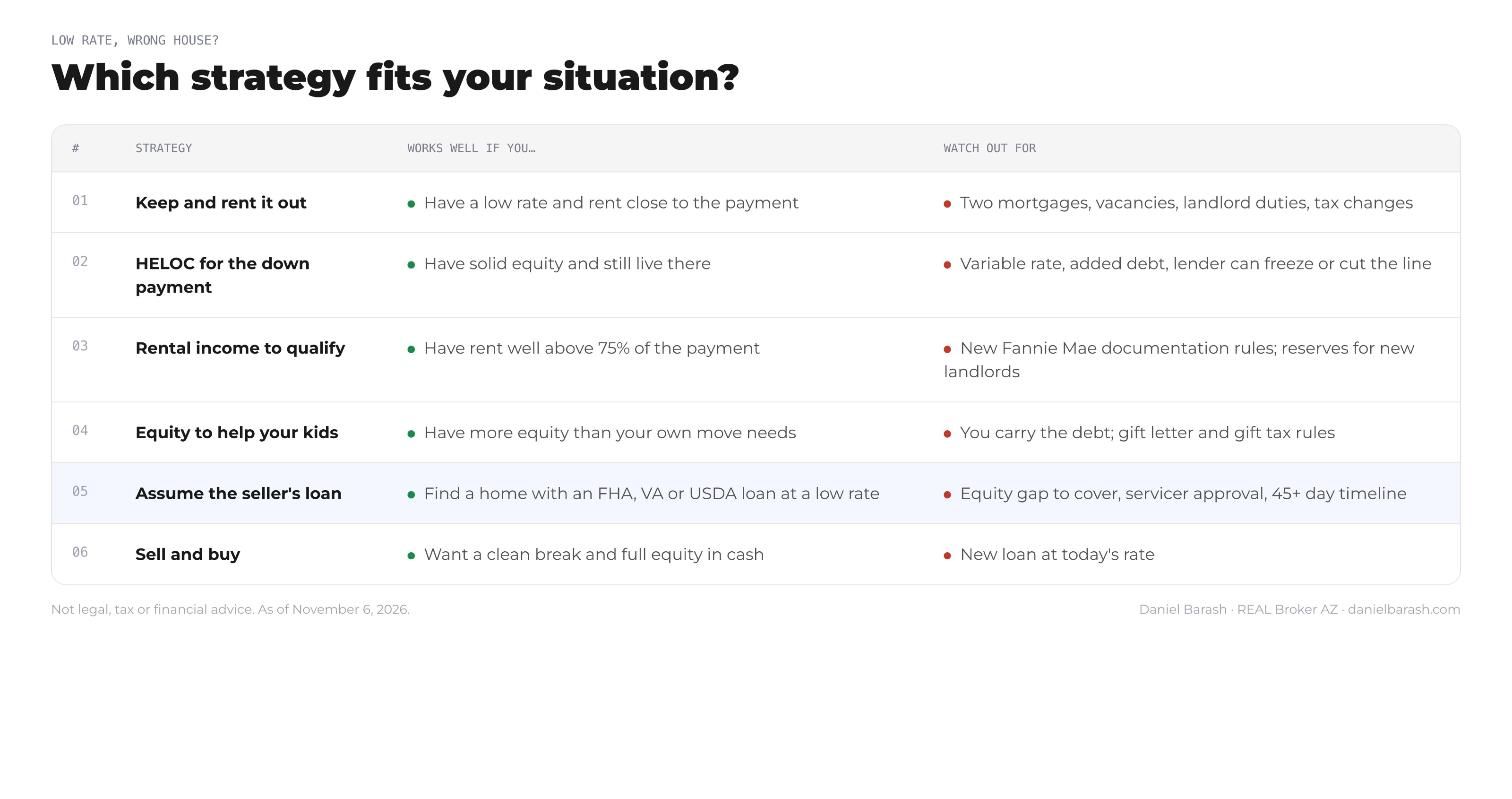
Honestly, selling is still the right call for plenty of people. If you don't want a landlord's phone ringing at 9 pm about a broken AC in July, that counts. So does a big gain that's close to the exclusion limit. I'd rather you sell and sleep well than hang onto a 3% loan you resent.
If you're buying the next home, there are also ways to bring that new rate down, including seller-paid buydowns, builder incentives and assumable loans. I covered those in How to Get a Lower Mortgage Rate in Phoenix in 2026. For example payments at today's rates, see my October 2026 mortgage rates post.
Frequently asked questions
Can I keep my low mortgage rate if I move?
Not on the new home. Your rate stays with the loan on your current house. What you can do is keep that house and its loan, rent it out, and get a new loan for the next home. You'd carry two mortgages, so talk with a lender about whether the numbers work.
Can rent from my current home help me qualify for a new mortgage?
It can. Lenders typically count 75% of the market rent and subtract the old home's full payment. A positive result offsets that payment; a negative one counts as debt. Fannie Mae now uses market rent, not a lease, for departing residences on applications dated November 1, 2026 or later. Ask your lender which rules apply to your loan.
Can I get a HELOC on a house I'm renting out?
It may not be an option. Many HELOCs are set up for homes you live in, and the CFPB notes a line "might require you to live in the home as your primary residence." If you plan to use a HELOC, apply while it's still your primary home and read the occupancy terms.
Do I lose the capital gains exclusion if I rent my house out?
Not right away, but you can. You generally need to have lived in the home for at least two of the five years before you sell. Rent it out much longer than three years and the exclusion may no longer apply, and depreciation is taxed when you sell. Talk to a CPA before you decide.
Can I assume the seller's mortgage on my next home?
Only if it's an FHA, VA or USDA loan and the servicer approves you. You take over the seller's balance and rate, then cover the gap between that balance and the price with cash or a second loan.
Want to run your numbers?
If your rate is keeping you in a house that no longer fits, I'm glad to talk it through: what your home might rent for, what it might sell for, and what the next home could cost. I'll bring in a lender and you should bring in a CPA, so you're deciding with real numbers. Reply to any of my emails or call or text me at 480.906.3831. No pressure.
If you're getting out this month, here are things to do in Phoenix, Tempe and Chandler in November.
Payment and rent figures are examples, not a loan offer. This is not legal, tax or financial advice; talk with a licensed lender and a CPA about your situation. Rates, lending rules and tax rules as of November 6, 2026, subject to change. Header photo: aerial view of housing subdivisions near Fountain Hills and the McDowell Mountains, March 2018, by Carol M. Highsmith, Carol M. Highsmith Archive, Library of Congress, Prints and Photographs Division (no known restrictions on publication).
Sources
- Realtor.com Q2 2026 Outstanding Mortgage Data (FHFA National Mortgage Database), press release via Nasdaq
- Freddie Mac Primary Mortgage Market Survey, Oct. 29, 2026
- Fannie Mae Selling Guide B3-3.8-05, Rental Income from Non-Subject Property: Departing Residence
- Fannie Mae Selling Guide Announcement SEL-2026-08, Sept. 2, 2026
- Fannie Mae Selling Guide B3-4.3-04, Personal Gifts
- CFPB: What You Should Know About Home Equity Lines of Credit
- Arizona Department of Revenue: Residential Rental Guidelines
- Arizona Department of Revenue: Residential rental tax changes, Dec. 11, 2024
- Maricopa County Assessor: Rental registration FAQ
- IRS Tax Topic 701, Sale of your home
- IRS Publication 523, Selling Your Home
- IRS: Frequently asked questions on gift taxes
About the author: Daniel Barash has spent 10 years in Phoenix-area real estate and works with buyers, sellers and rental owners across Tempe, Chandler and the greater Phoenix area with REAL Broker AZ, LLC.
Daniel Barash | REAL Broker AZ, LLC | 480.906.3831
Categories
Recent Posts










"My job is to find and attract mastery-based agents to the office, protect the culture, and make sure everyone is happy! "